By Dalal AlRayes, Co-founder & CEO at Spare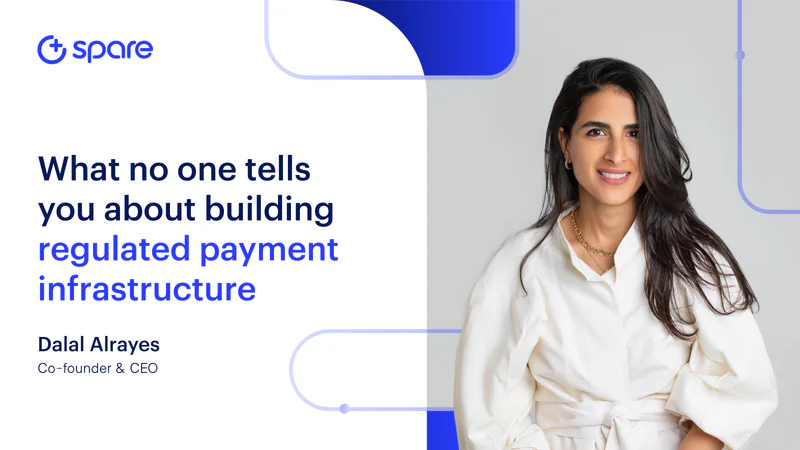
When businesses come to us, they usually want one thing: to accept payments. What they rarely see is everything that has to line up before a single payment can happen.
In open finance, a payment isn't a card swipe. It's a customer granting consent, authenticating directly with their bank, and money moving account-to-account in real time.
This is cleaner for everyone, but only if the infrastructure underneath behaves. That infrastructure is not something you build once and ship, rather it's a continuous, market-by-market commitment to compliance, connectivity, and trust. In a region like the GCC, where every country runs its own framework, that commitment compounds fast.
This is the part we don't talk about enough.
Every market is its own problem to solve
Saudi Arabia runs its Open Banking ecosystem under SAMA's Open Banking Framework. The UAE operates under the Central Bank of the UAE's Open Finance framework, with payments initiated through AlTareq. Bahrain has its own licensing model under the Central Bank of Bahrain. There is some overlap, but each framework carries its own requirements, its own API standards, its own consent flows, and its own authentication flows.
For a merchant, this should be invisible. For us, it is the entire job. When Spare connects a business to open banking infrastructure in any of these markets, we are not just providing an API. We are carrying the regulatory relationship, holding the compliance posture, maintaining live connectivity with banks, and keeping pace with frameworks that are still evolving. That’s what a licensed Third-Party Provider actually does, and it’s not a small thing.
The part that is easy to underestimate
Before founding Spare, I spent years in private equity, watching business struggle not because of a flawed product or service, but because the infrastructure underneath it was never built to last. Open finance in regulated markets is exactly that kind of problem. It looks simple from the outside, and almost all of its difficulty sits hidden below the surface.
Bank come online at different speeds and reliability varies. API documentation is inconsistent. Consent flows need to be built and maintained across multiple institutions. Regulatory requirements update, and someone has to track them, interpret them, and implement them. When something changes in the framework, it cannot wait.
Most businesses have neither the appetite nor the license to build this themselves, and they shouldn’t have to.
Why we built Spare the way we did
From day one, we made a deliberate decision to absorb this complexity rather than pass it on. One integration. Three markets. Compliance inherited by default. A merchant connects to Spare once, and everything underneath from banks, consent flows, authentication, and regulatory upkeep is handled on our side.
That single decision shaped how we build, how we hire, and how we operate. It’s the harder way to build a company. But it is the right way to build infrastructure.
The businesses we work with are busy with their own products, their own customers, their own growth. The last thing they should be thinking about is whether their payment integration is compliant with the latest update to a regulatory framework in a market they are trying to enter.
That part is ours and we take it seriously.
What this means for the region
The GCC is at an inflection point. Regulatory frameworks are maturing, bank connectivity is improving, and businesses are moving from curiosity to deployment. As that happens, the infrastructure layer is becoming more and more important.
Getting it right matters. Not just commercially, but for the long-term credibility of Open Banking in the region. Every payment that goes through smoothly, every merchant that launches without compliance friction, every customer that completes a transaction securely builds business and customer trust at scale.
We’re here to make that possible. Quietly, consistently, and at the infrastructure level where it counts.
To learn more about how Spare can help you build on Open Finance,
reach out to hello@tryspare.com.